.svg)

Invasive Plant Removal in Virginia
Stop Fighting the Thorns. Give Your Land Room to Breathe.
Your land is slowly being taken over and it is not stopping on its own. Invasive plants like multiflora rose, autumn olive, and Chinese privet spread aggressively, choking out native growth, reducing wildlife habitat, and turning usable property into dense, unmanageable brush. Most landowners try to fight it with mowers or piecemeal clearing, only to watch it come back thicker.
You should not have to settle for temporary fixes that let invasive plants and invasive trees take over.
That is where Branch Manager comes in. We guide you through a simple and effective solution using forestry mulching to remove invasive species at the root, restore access, improve land value, and help you take back control of your property in just one pass.
Forestry Mulching for Invasive Plant Removal
.svg)
Shreds overgrowth in one pass. It turns a tangled mess into a clean slate instantly, no hauling required.
Precisely clears brush without harming hardwoods. Removing competition gives your trees more sun and water.
Protects the ground by adding organic mulch. This layer retains moisture and enriches the soil naturally.
The mulch carpet blocks sunlight, suppressing growth and stopping invasive plants from taking back your land.

Learn our process directly from The official branch manager
Branch Manager turns messy brush into clear land covered in fresh mulch. We use professional machines to clear paths you can actually walk on, making your whole property useful again. Our earth-conscious process protects your soil and instantly increases your property value.

Stop invasive plants from taking over your property.
Return nutrients back to your soil.
Reclaim your land and make it usable again.
How Forestry Mulching Works
We evaluate brush density, terrain, and access points
Our machines grind brush, saplings, and small trees into mulch
The area is cleared, walkable, mowable, and ready for immediate use
Why Choose forestry mulching?

We mulch on-site to return nutrients to the soil, naturally fertilizing your hardwoods as it decomposes.
Our Forestry mulching equipment disrupts the root base to reduce invasive return.
Most trails are finished in a single day, leaving your land ready to use immediately.
Clear access, walkable space, and room to enjoy, build, or work without fighting through overgrowth.
Clearing invasive plants allow native species and wildlife to return.
We cut, grind, and clear brush. You get a level, trip-free surface that is safe for feet, tires, and hooves.
The invasive Species taking over Central Virginia
A thorny, arching shrub that forms impenetrable thickets up to 10 feet tall. Spreads by birds eating its berries. One plant produces a million seeds a year. Covers more Virginia acreage than any other invasive shrub.
.svg)
Closes trails, chokes food plots, crowds out native trees
A fast-growing shrub that fixes its own nitrogen, giving it an unfair advantage over native plants. Produces thousands of berries spread by birds. Dominates forest edges, old fields, and roadsides across Virginia.
Suppresses native vegetation, dominates field edges and openings
An evergreen vine that climbs trees and smothers everything beneath. Keeps its leaves year-round, blocking light even in winter. One of the most widespread invasives in the mid-Atlantic region.
Girdles young trees, smothers understory, spreads across forest floors
Grows up to a foot per day in summer. Covers trees, power lines, and structures completely. Once established, the root system can be massive. Common across Southern and Central Virginia roadsides and bottomlands.
Covers and kills entire tree canopies, blocks all other vegetation
A dense, semi-evergreen shrub that was widely planted as a hedge and escaped into wild areas. Forms dense thickets in forest understories, stream banks, and disturbed ground. Very difficult to clear by hand.
Dominates stream corridors, shades out native understory plants
A fast-growing tree that sprouts in disturbed soil, fence lines, and forest edges. Produces allelopathic chemicals that inhibit the growth of other plants. Host for spotted lanternfly, a major new threat to Virginia agriculture.
Spreads aggressively from root sprouts, difficult to kill once established
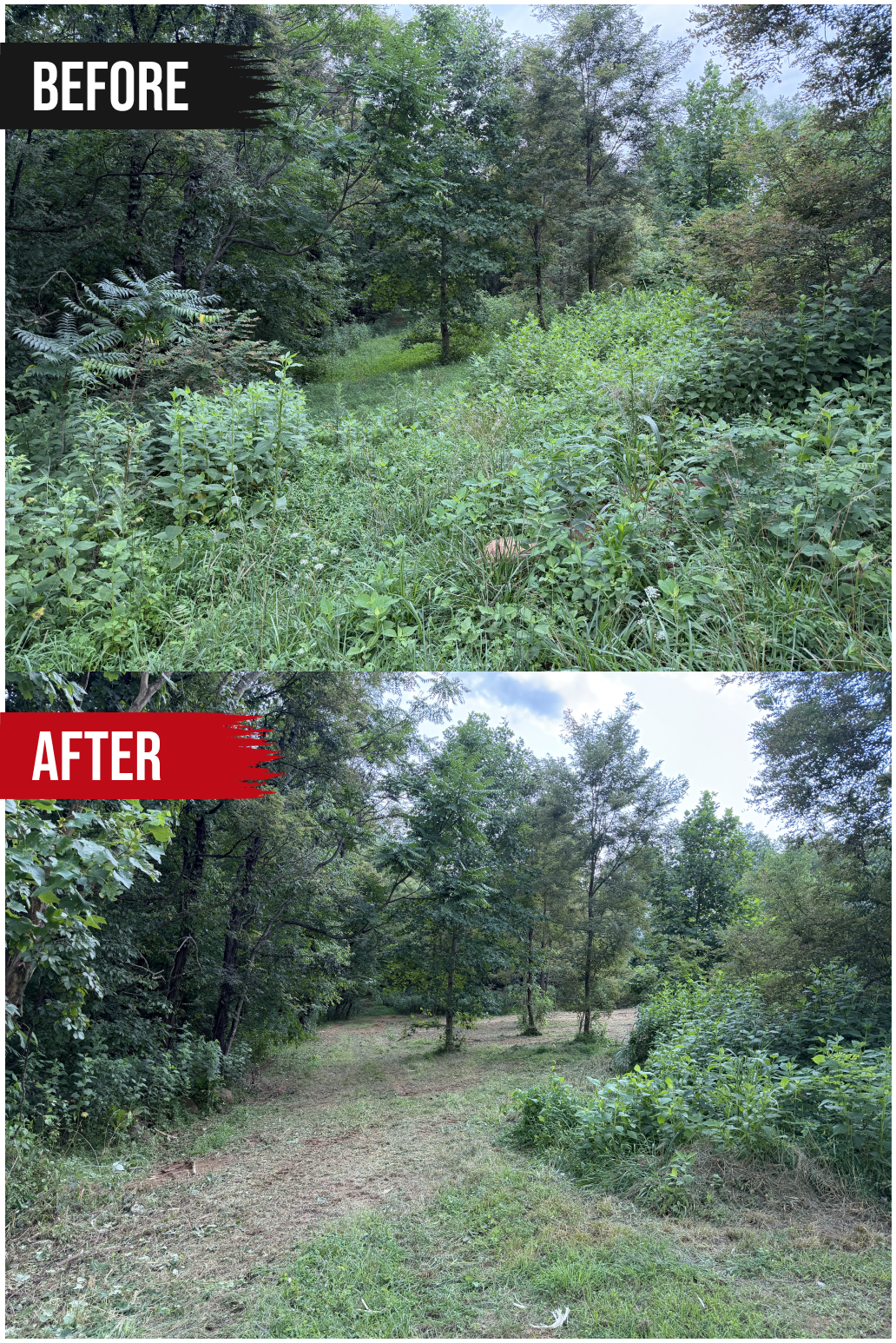
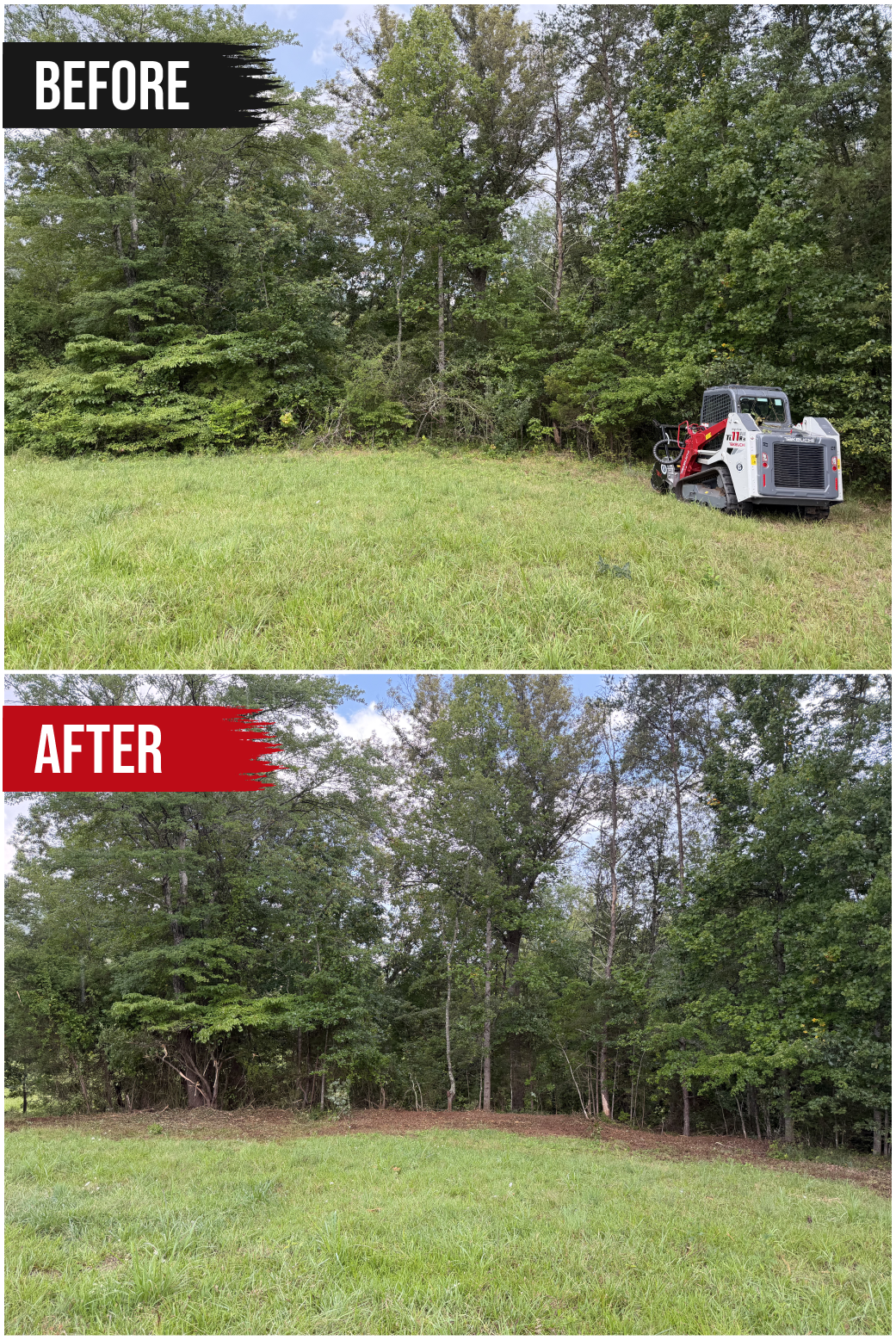
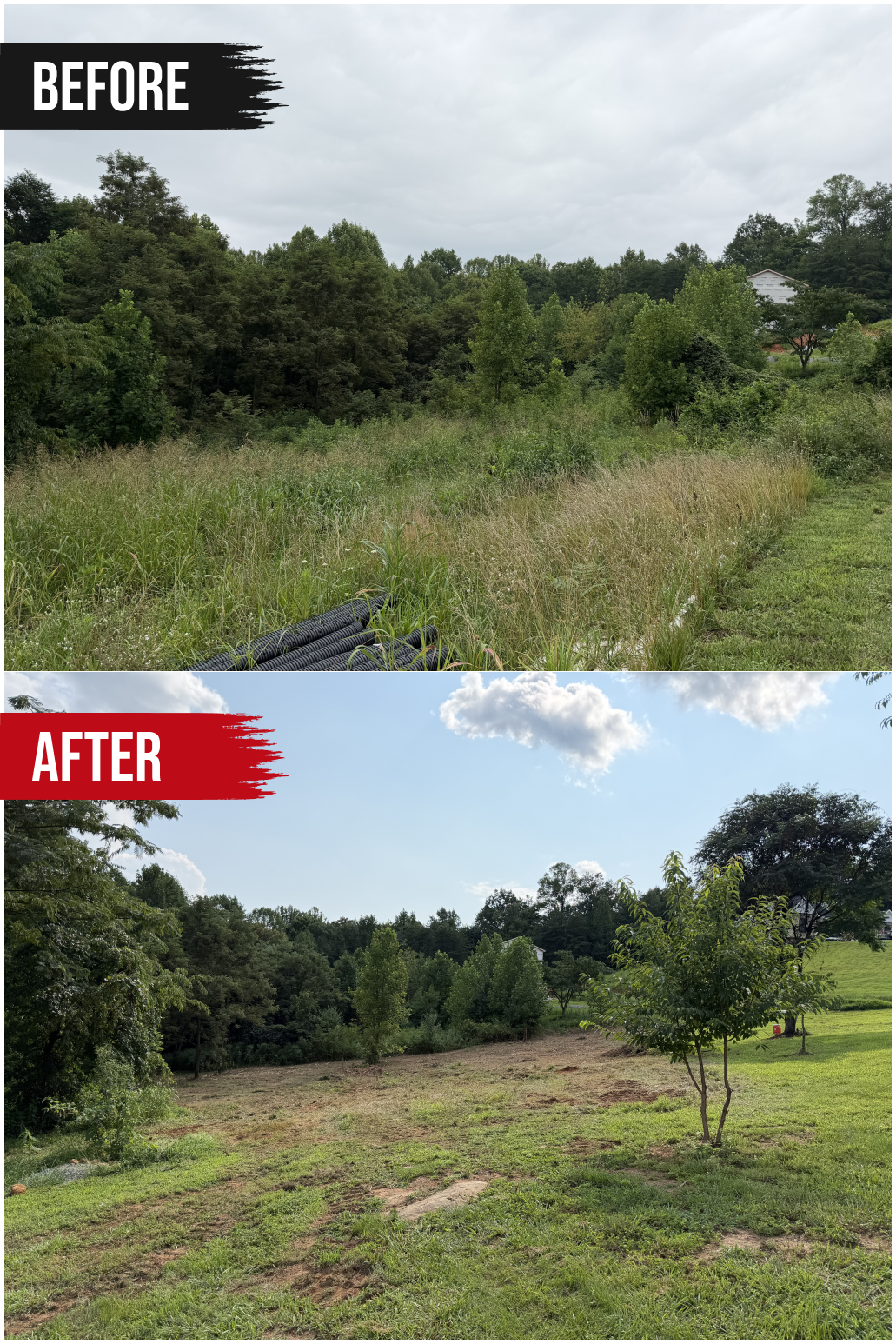
Real Results Real Transformation
Curious about Pricing?
What we clear, cut & reclaim
Overgrown hiking trails, hunting access lanes, horse paths, ATV/UTV corridors, and walking paths on private property. We cut winding trails through dense brush and maintain existing ones.
Our primary method for large-scale land clearing. One machine shreds trees, brush, and vegetation into ground-covering mulch — faster, cleaner, and less disruptive than traditional clearing or bulldozing.
Multiflora rose, autumn olive, Japanese honeysuckle, privet, wisteria — we target and clear the invasive species choking your native trees, food plots, and property access.
Got a property that hasn't been maintained in years? We specialize in land reclamation — transforming inaccessible, overgrown acreage back into usable, enjoyable, and sellable land.
Dense thickets, brambles, briars, and tangled underbrush cleared efficiently with minimal ground disturbance. Improves visibility, reduces pest habitat, and opens your land back up.
Reclaim overgrown food plots, neglected pastures, and field edges. We clear woody growth and invasive brush so your soil — and your wildlife program — can thrive again.
Frequently Asked Questions
What invasive plants do you remove?
A: We remove many of the most common invasive plants found throughout Central Virginia, including autumn olive, multiflora rose, tree-of-heaven, Japanese honeysuckle, Chinese privet, English ivy, oriental bittersweet, Japanese stiltgrass, wineberry, kudzu, and more.
Is forestry mulching an effective way to remove invasive plants?
A: Yes. Forestry mulching is an effective way to remove dense invasive brush, vines, and small trees while minimizing soil disturbance. We are not a pesticide or herbicide company, so while we remove the existing growth, some invasive species may require follow-up herbicide treatment by a licensed applicator for long-term control.
Can you remove invasive plants without damaging healthy trees?
A: Absolutely. We specialize in selective clearing, removing unwanted invasive vegetation while preserving healthy native trees and desirable plants whenever possible.
Will invasive plants grow back after they're mulched?
A: Some invasive species can regrow from roots or remaining seeds. Forestry mulching removes the existing vegetation, but long-term control may require follow-up maintenance or targeted herbicide treatments depending on the species.
Why should I remove invasive plants from my property?
A: Invasive plants crowd out native vegetation, reduce wildlife habitat, block trails and fence lines, increase maintenance costs, and can make your property difficult to use. Removing them helps restore healthier, safer, and more usable land.
When is the best time of year to remove invasive plants?
A: Forestry mulching can be performed year-round, but fall, winter, and early spring are often ideal because vegetation is easier to access, wildlife disturbance is reduced, and you can better see the structure of your property before new growth begins.
How much does invasive plant removal cost?
A: The cost depends on the size of the property, the density of the invasive growth, terrain, and accessibility. We provide fixed-price estimates so you'll know the cost before work begins. Get a quick estimate by using our Instant Pricing Calculator
Do you remove vines growing on trees and fence lines?
A: Yes. We clear invasive vines and overgrowth around fence lines, trails, woodland edges, and other accessible areas. During your site visit, we'll determine the safest and most effective approach for your property.
.svg)
.svg)

.svg)
Reclaim Your land Without Breaking your back

Counties we serve
Branch manager, LLC.


